JAMB 2027 Registration: Six Things to Do Before the Form Is Out
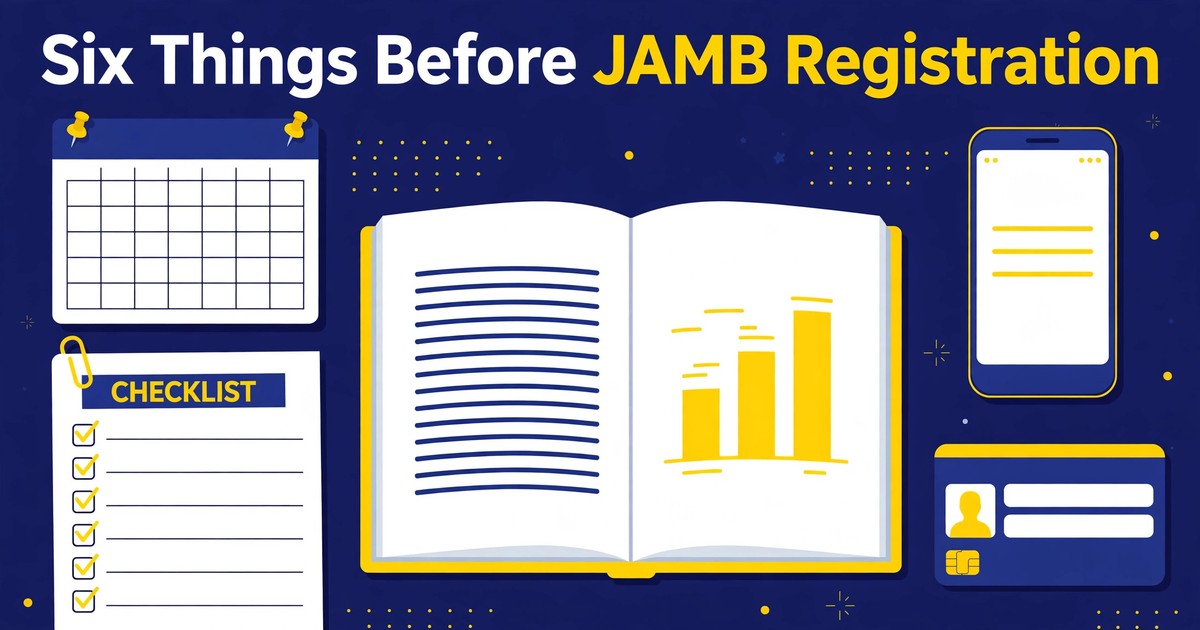
JAMB 2027 registration has not started, and JAMB has not announced a registration date or a fee for the 2027 UTME. What you can do now is prepare. In an advisory shared on its official platforms on Monday 9 November 2026, JAMB listed six things prospective candidates should settle before registration begins: verify your NIMC biodata, get a registered phone number, provide an active email address, decide on your preferred course, choose your preferred institution, and select the right UTME subjects. This guide explains each item in turn, shows you how to check your course requirements free on JAMB’s IBASS portal, and states clearly what JAMB has not announced yet, so that nobody sells you a date or a fee that does not exist.
JAMB published the list early for a reason. Most registration problems are created before registration starts: a name that does not match across documents, a phone number the candidate no longer controls, a subject combination that does not fit the chosen course. The board says the checklist is meant to help candidates stay organised, prepare effectively and avoid common mistakes during the registration and admission process. None of the six items costs money at a registration centre, and all six can be done from home or through NIMC and JAMB’s own free portals.
Quick Facts
| Item | Detail |
|---|---|
| Registration status | Not started. JAMB has announced no start date, no closing date and no fee for the 2027 UTME |
| Source of the checklist | Advisory shared on JAMB’s official platforms on Monday 9 November 2026 |
| Proposed UTME window | 15 to 25 March 2027, from the Federal Ministry of Education harmonised calendar. Proposed, not confirmed by JAMB |
| Where to check requirements | IBASS, the Integrated Brochure and Syllabus System, at ibass.jamb.gov.ng |
| Full 2027 exam calendar | See our guide to the 2027 exam timetable for WAEC, NECO, JAMB and NABTEB |
JAMB 2027 registration: the six things on JAMB’s list
Work through the six items in order. The first three protect your identity and your access to your own profile. The last three protect your admission chances, because they decide whether the course you register for can actually admit you.
1. Verify your NIMC biodata
JAMB builds your UTME profile from the records attached to your National Identification Number (NIN), which NIMC holds. The spelling and order of your names, and your date of birth, are taken from that record. Check them now against your birth certificate and your school documents. If anything differs, for example a changed name order, a wrong date of birth or a misspelt surname, get the correction done through NIMC’s authorised channels before registration opens. JAMB has warned in past cycles that biodata corrections after registration are difficult, and that changes may not be effected through the ordinary registration process once an application is completed. If you have no NIN at all, enrol at an approved NIMC registration centre first. Without a NIN, nothing else on this list can move.
2. Get a registered phone number
You need a phone number that is registered, active and yours, and that will stay with you through registration, the examination and admission. JAMB registration starts with a profile code, which is generated from your NIN through the phone number you present, and later messages about your application come back to the same number. Do not borrow a parent’s, a sibling’s or a cafe operator’s number for convenience. If that SIM is lost or the owner travels, your profile is stranded with it. Keep your own SIM safe and funded. JAMB has also set out a controlled procedure, through designated centres and identity verification, for candidates who genuinely lose access to a registered number or email address, but sorting that out mid registration is stress you can avoid entirely by starting with a number you control.
3. Provide an active email address
Create an email address, or confirm the one you already have, and make sure you can open it today with a password you know. Your email becomes part of your JAMB profile and one of the channels through which official information reaches you during registration and admission. Avoid accounts created for you at a cafe whose passwords you never received. Write your login details down somewhere private, sign in once to prove they work, and check the inbox regularly from now on, because preparation updates and, later, admission related messages can land there at short notice.
4. Decide on your preferred course
Settle the programme you want to study before the registration portal opens, not at the centre while a queue waits behind you. For each course you are considering, check three things on IBASS: the O’level credits required, the UTME subject combination, and any special conditions the institution attaches to the programme. Choose with your actual results and strengths in view, not only with the prestige of the course name. A competitive course you are eligible for is a better registration than a famous course whose requirements you do not meet. Our guide to JAMB subject combinations for all courses explains how course choice and subjects connect, and you can start planning your reading with the JAMB syllabus for all subjects.
5. Choose your preferred institution
Decide which university, polytechnic or college of education you want most, and identify realistic alternatives before you register. Confirm that the institution actually offers your course, think about its location and what studying there would cost your family, and look at how competitive the course has been in recent admissions. Our guide to JAMB cut off marks for all universities explains the national minimum scores and how departmental marks work. Candidates who register first and research afterwards are the ones who later pay for change of institution and spend weeks correcting a rushed choice.
6. Select the right UTME subjects
Every UTME candidate sits four subjects: Use of English, which is compulsory, plus three others that must match the chosen course. This is the item candidates get wrong most quietly. In a separate advisory shared through its JAMB Explained platform on 6 November 2026, JAMB warned that a candidate can have good UTME scores and good O’level results and still not be eligible for admission if the subject combination does not meet the requirements of the chosen programme. Requirements also differ between institutions for the same course name. Confirm your combination on IBASS for your exact institution and course, rather than copying the combination a friend used for a different school.
How to check your requirements on IBASS
JAMB directs candidates to its Integrated Brochure and Syllabus System, IBASS, as the authoritative place to confirm requirements. The steps the board published are:
- Visit ibass.jamb.gov.ng.
- Open the Brochure section.
- Choose the option to view all institutions.
- Use the institution filter to find your preferred university, polytechnic or college of education.
- Select your desired course.
- Click View Details to see the approved O’level subject requirements and the UTME subject combination for that programme.
IBASS also carries the syllabus for every UTME subject, so the same visit that confirms your combination can start your reading plan. The service is free, and checking takes a few minutes. Do it for your first choice institution and for any alternative you are seriously considering, because the same course can carry different requirements at different schools.
What JAMB has not announced yet
Be clear about what does not exist yet. JAMB has not announced a registration start date for 2027, a closing date, a registration fee, or a final examination timetable. The window of 15 to 25 March 2027 that is circulating comes from the harmonised examination calendar published by the Federal Ministry of Information and National Orientation on 14 October 2026, and both the Ministry and JAMB describe those dates as proposed, subject to confirmation by the examination bodies. Our 2027 exam timetable guide tracks the proposed dates for JAMB, NECO, WAEC and NABTEB in one place and marks what is confirmed and what is not. Treat any website, agent or social media post quoting a 2027 registration date or a fee as unverified until JAMB itself announces it, and pay nobody for a form that is not out. When the announcement comes, it will appear on jamb.gov.ng and the board’s verified platforms first, and this guide will be updated with it.
When registration opens, our full JAMB Registration Guide walks through the profile code, the e-PIN and the CBT centre steps in order.
Common mistakes to avoid
- Registering with a phone number or an email address that belongs to somebody else.
- Ignoring a name or date of birth mismatch between your NIMC record and your school documents until registration week.
- Copying a friend’s subject combination without checking IBASS for your own institution and course.
- Choosing your course and institution at the registration centre, under time pressure.
- Treating the proposed March 2027 examination window as confirmed and making final plans around it.
- Paying an agent for early registration, a guaranteed slot or a leaked timetable before JAMB opens the exercise.
Key takeaways
- JAMB 2027 registration has not started, and JAMB has announced no date and no fee for it.
- The six things JAMB listed on 9 November 2026 are: verify your NIMC biodata, get a registered phone number, provide an active email address, decide on your preferred course, choose your preferred institution, and select the right UTME subjects.
- Course requirements and subject combinations can be checked free on IBASS at ibass.jamb.gov.ng, and a wrong combination can block admission even with good scores.
- The proposed UTME window of 15 to 25 March 2027 comes from the Federal Ministry of Education harmonised calendar and is not confirmed.
Frequently asked questions
Has JAMB 2027 registration started? No. As at 12 November 2026, JAMB has not opened registration for the 2027 UTME and has not announced a start date. The board has only published preparation guidance, including the six item checklist shared on its official platforms on 9 November 2026.
When will the JAMB 2027 form be out? JAMB has not said. The registration dates for 2027 will be announced on jamb.gov.ng and on the board’s verified platforms. Any date quoted elsewhere before that announcement is not official.
How much is the JAMB 2027 registration fee? JAMB has not announced the 2027 fee. The charges will be published with the registration announcement. Do not pay any agent a 2027 registration fee before then.
What are the six things JAMB wants candidates to do before registration? Verify your NIMC biodata, get a registered phone number, provide an active email address, decide on your preferred course, choose your preferred institution, and select the right UTME subjects for your course.
How do I check the correct subject combination for my course? Go to ibass.jamb.gov.ng, open the Brochure section, view all institutions, filter to your preferred institution, select your course and click View Details. The page shows the approved O’level requirements and the UTME subject combination for that programme.
Is the March 2027 UTME date confirmed? No. The window of 15 to 25 March 2027 comes from the Federal Ministry of Education harmonised calendar published in October 2026, and both the Ministry and JAMB describe it as proposed. JAMB will confirm the final examination dates in its own announcement.
Last updated: 12 November 2026
When JAMB opens registration, its announcement and instructions will be on the board’s official website: https://www.jamb.gov.ng/ and you can check course requirements at any time on IBASS: https://ibass.jamb.gov.ng/